
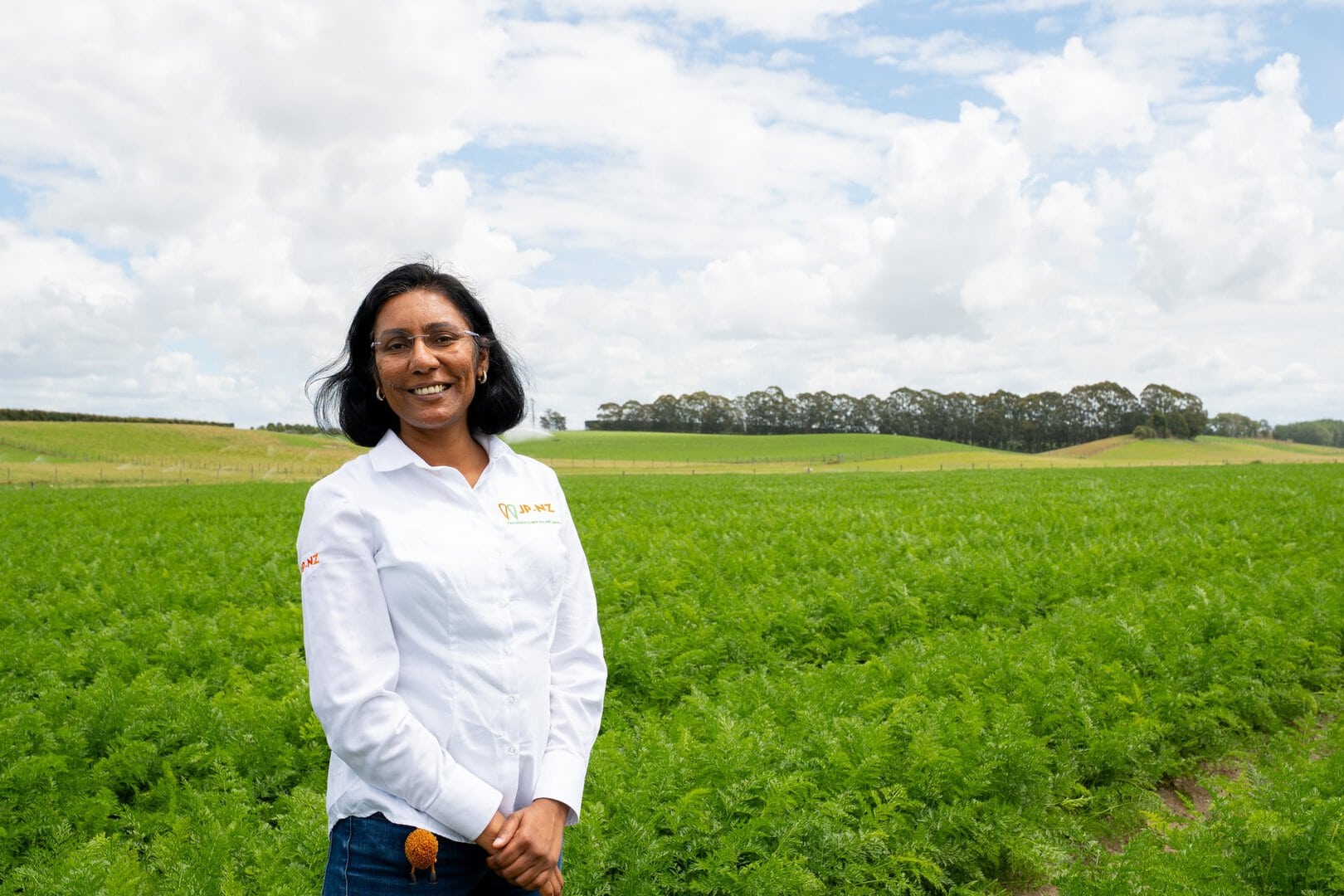
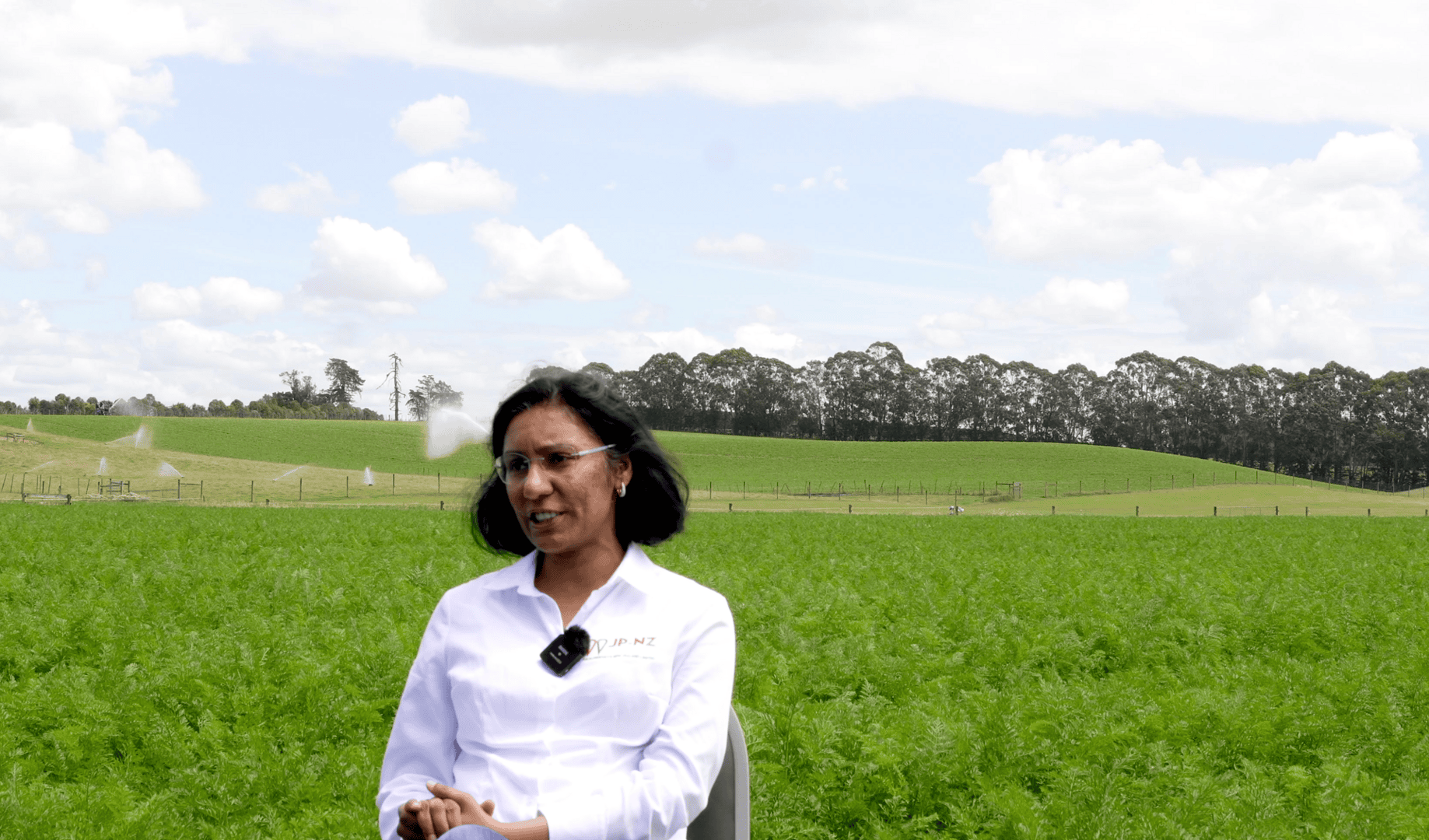
We met Vidya Kethireddy sitting in a carrot field — a fitting place to talk about a career built around one of the world’s most-loved vegetables. Vidya is the Technical and Quality Manager at Juice Products New Zealand. Her story moves from a small town in India to laboratories in the US, a PhD in Dunedin and then into the heart of South Canterbury’s food processing sector. Along the way she has stitched together agriculture, food science and quality assurance into a career that helps a local business reach global markets.
To watch a highlight video of the interview this article is based on, see below:
From a small town in India to South Canterbury
Vidya’s path wasn’t linear. Born in Kawali in Andhra Pradesh, she moved to a larger city to study and completed a bachelor’s degree in agriculture. After that she travelled overseas — first to the United States to study food science at master’s level, then back to India to work. Then some personal circumstances prompted another life decision: a new start in New Zealand.
She came to Dunedin to pursue a PhD in food science, working with supportive supervisors and building a new life. That PhD became more than an academic credential. It wove together her agricultural roots, food science training and microbiology knowledge into a practical toolkit that she now uses every day at Juice Products New Zealand.
Bringing quality and research together at Juice Products New Zealand
When Vidya applied for the role at Juice Products New Zealand, the company was at a turning point. She was hired to create and lead a robust quality systems function, combining research and development with quality assurance and control. By establishing systems capable of achieving recognized international standards — including SQF (Safe Quality Food) certification — the company strengthened its credibility in global markets.
Some key facts about Juice Products New Zealand that show how a regional business can reach the world:
- Scale: The company processes an estimated 60% of New Zealand’s carrot crop, making it a major player in the country’s produce processing sector.
- Market leadership: It is one of the largest carrot juice concentrate producers in Australasia and among the world’s leading processors for this product.
- Exports: About 85% of production is exported to Japan. Other markets include Southeast Asia, the United States and Australia, and the company is expanding into China, the Middle East and India.
- Workforce: The company began as a small team and remains a small-to-medium enterprise with a tight-knit staff, currently around 48 full-time employees.
That combination of scale and small-business culture is rare. Vidya highlights how an entrepreneurial origin — local founders building the company on the strength of a single export contract — evolved through investor interest to the present day, while maintaining strong ties with local growers.
Carrots: more than orange and more than a commodity
Sitting in the carrot field makes one fact immediately clear: carrots are diverse. Vidya tells us that the original carrots were purple and that the orange varieties we take for granted today were bred later. The different colours are not merely cosmetic — each pigment brings distinct nutritional qualities:
- Purple carrots: Contain anthocyanins, antioxidants associated with heart health and anti-inflammatory benefits.
- Yellow carrots: Contain lutein, which supports eye health.
- Orange carrots: Rich in beta-carotene, a precursor to vitamin A and vital for vision and immune function.
These pigments make different coloured carrots valuable ingredients for juice manufacturers. Carrot juice concentrate is commonly blended with other fruit and vegetable juices — especially in markets like Japan, where consumers often expect “five a day” type blends that deliver multiple vegetable servings in a single carton.
Because Juice Products New Zealand can supply bulk carotenoid-rich concentrates, they are an important ingredient for those blends. This demonstrates how a single regional processor can influence the nutritional profile of packaged beverages sold across international markets.
Beyond whole juice: product innovation and collaboration
Innovation is happening on several fronts. Vidya has led work toward turning processing waste streams into value-added products — a classic circular-economy approach that reduces waste and creates new revenue streams. Commercialising these innovations remains one of her proudest achievements.
The company also works with local brands on contract manufacturing. A recent collaboration with Barkers resulted in a shelf-ready product made with Canterbury apples and the company’s beetroot and purple carrot concentrates. These local collaborations connect regional ingredients to local retail shelves and show how processors can support local supply chains and product development.
Grower partnerships and a community-first approach
Processing 60% of New Zealand’s carrots would not be possible without strong relationships with growers. Vidya emphasises that those partnerships date back to the company’s origins and have been built on trust and mutual support. Growers supported the enterprise in early days and continue to provide the volume and quality needed for large-scale processing.
That partnership model offers several advantages:
- Supply stability: Long-term relationships smooth harvest peaks and supply variability.
- Quality alignment: Grower knowledge of crop varieties and agronomy helps processors maintain consistent product specifications.
- Community resilience: A regional processing hub helps retain economic value locally, supporting jobs and secondary services.
Lessons in leadership, life and professional growth
We often expect leaders to preach one-line mantras. Vidya offers something more grounded: a set of values and lessons shaped by experience. Two of her guiding principles stand out.
Integrity above all. Vidya says, “There is nothing in this world that is more valuable than your integrity.” That value has guided decisions and built trust in teams and with external partners.
Know yourself and be honest about what you know and do not know. She believes qualifications do not guarantee knowledge. Practical experience, curiosity and passion often make the bigger difference. Her own path — from agriculture to laboratory to management — demonstrates how combining disciplines gives leaders a richer perspective.
Her practical advice for emerging leaders: “It’s okay to be wrong — progress, not perfection.” Embracing iterative improvement, making decisions, learning from mistakes and moving forward matters more than waiting for an impossible ideal of perfection.
Practical lessons we can adopt
- Focus on integrity and transparent communication in teams and with partners.
- Value cross-disciplinary skills — agriculture, science and quality systems can work together effectively.
- Prioritise learning through doing rather than overvaluing credentials alone.
- Accept mistakes as part of growth. Small adjustments add up to meaningful progress.
Challenges and wins — a balanced perspective
Moving countries, rebuilding a life and building professional capability all come with challenges. Vidya reflects on moments that tested and expanded her: the first time she flew on an aeroplane, the emotional strain of personal upheaval, and the practical difficulties of relocating multiple times.
Yet those challenges produced tangible wins. A summary of the achievements that stand out:
- Educational milestones: Completing a PhD that integrated agriculture, food science and microbiology and helped shape a practical career.
- Systems and standards: Building quality systems that earned SQF certification and opened global markets.
- Commercial innovation: Progress toward creating value-added products from processing waste.
- Community integration: Becoming part of a company and town where colleagues feel like family.
Those wins show the multiplier effect of combining technical knowledge with community relationships and business systems.
South Canterbury: why it works as a place to live and build a business
Vidya chose to stay in South Canterbury because of the lifestyle, the people and the slower pace that enables focus and balance. She notes the region’s hospitality, the genuine camaraderie at work and the accessibility of life that allows breathing room to pursue work and family commitments.
For those considering moving to the region, Vidya’s message is simple: bring new ideas and energy. Diversity of perspectives strengthens the local ecosystem and helps businesses adapt and grow.
How the local business ecosystem supports growth
Local organisations play a catalytic role. Working with the South Canterbury Chamber of Commerce has helped Juice Products New Zealand in practical ways — export support, introductions to local manufacturers and access to leadership development programs.
Participation in business awards and development programs also forces a company to reflect — to examine strengths and weaknesses, set direction and articulate growth plans. These processes can be as valuable as any technical upgrade — they shape organisational behaviour and performance.
Programs and supports that make a difference
- Export assistance and trade introductions to expand into overseas markets.
- Leadership development sessions to grow capability within the company.
- Business awards and benchmarking to encourage continuous improvement.
Practical advice for people thinking of moving here or starting in food processing
If we had to condense Vidya’s advice for newcomers into actionable steps, they would look like this:
- Be open to change: Every move brings discomfort. See it as an opportunity to grow rather than a setback.
- Build relationships: Seek out colleagues, growers and local organisations — a strong network is invaluable in regional economies.
- Combine skills: Cross-discipline experience — for example, farming knowledge plus lab science — creates unique value.
- Be prepared to learn on the job: Qualifications are useful, but curiosity and hands-on problem solving will carry you further.
- Embrace incremental progress: Aim for progress, not perfection. Small, consistent improvements compound into major gains.
Why Vidya’s approach matters beyond carrots
The story here is not just about a plant or an ingredient. It is about how technical knowledge, a community-first mindset and a willingness to experiment can transform a regional business into a global supplier. It shows how regional economies can anchor global value chains while keeping benefits local.
Vidya’s blend of scientific rigor, respect for growers and commitment to quality systems creates a model that other regional food processors can emulate. It’s a reminder that deep technical skill combined with ethical practice and community partnership builds both resilience and opportunity.
For more articles like this, visit the South Canterbury Website.









Join the South Canterbury Chamber of Commerce.
Do better business, together.
Join New Zealand’s most respected business organisation today!
The Chamber can help you grow your networks and your business.

Get the right advice,
be better informed.
FREE business support and advice. FREE 0800 helpline for HR and Health & Safety advice.

Connect with the right people.
Reach 5,000+ potential new customers, network at BA5 and other events, Sector and Young Chamber CONNECTIONS.

Upskill yourself and your team.
FREE essential workshops, DISCOUNTED training, specialised information seminars.